

Sep 10, 2026
The Next Fraudulent Insurance Claim May Look Perfect
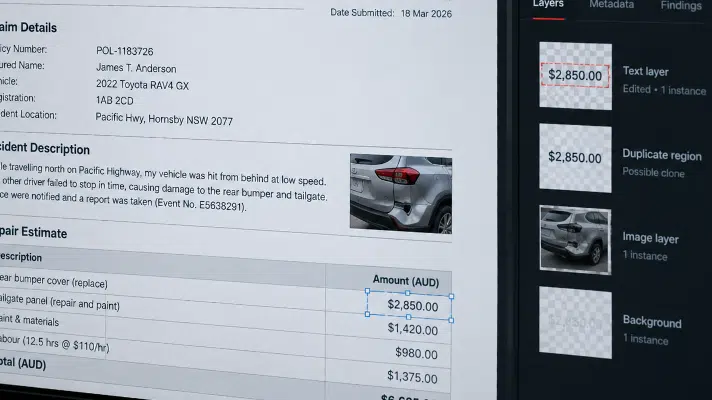
The next wave of insurance fraud in Australia may not arrive with spelling mistakes, obvious alterations or paperwork that appears visibly fraudulent.
It may look clean and credible or use the insurer’s own policy language. It may be supported by a carefully written explanation, a plausible invoice, a convincing medical certificate or an image that appears to show exactly what the claimant says it does.
That is what makes the risk increasingly difficult to manage. Insurance fraud is no longer simply a question of identifying evidence that looks suspicious. Increasingly, insurers need to determine whether the evidence supporting a claim can be trusted.
Australian insurers are already operating under considerable pressure. According to the Insurance Council of Australia, extreme weather events generated $4.8 billion in insured losses in 2025, up 727 percent on the previous year. At the same time, insurers are expected to assess and settle claims quickly, often within predetermined timeframes that can limit the opportunity for detailed scrutiny.
The Insurance Council of Australia has previously reported $560 million in detected opportunistic motor and property fraud in 2023, while undetected fraud is estimated to cost the sector around $400 million annually. General insurance complaints to AFCA reached 34,231 in 2024-25, an increase of 17 percent.
This creates a difficult balance for insurers. The overwhelming majority of customers are genuine and require fair, efficient claims handling, often at a stressful point in their lives. However, even a relatively small proportion of fraudulent or inflated claims can generate substantial financial losses, operational pressure and reputational risk.
The solution cannot be to subject every claim to greater friction. It requires more intelligent and targeted detection.
Generative AI Has Changed the Fraud Equation
Generative AI has made it considerably easier to present questionable claims in a credible and professional form.
A weak claim can now be supported by language that appears informed, procedural and legally confident. A short complaint can be expanded into a detailed argument. Policy wording can be copied, interpreted and incorporated into a claim in ways that make the submission appear more credible than the underlying evidence warrants.
However, the problem is broader than generative AI. Many fraud attempts continue to rely on familiar techniques, conventional editing software and genuine documents that have subsequently been altered.
A medical certificate may be authentic but have its dates changed or be reused for another purpose. A repair invoice may appear legitimate but have its value inflated. A veterinary bill, supplier quote, payslip or proof-of-loss document may originate from a genuine source while still being manipulated before submission.
For insurers, this creates a significant challenge: the document may appear legitimate even when the claim it supports is not. The vulnerability often sits at the evidence layer. Claims can depend on documents and images supplied by customers, repairers, doctors, employers, suppliers, brokers, veterinarians and other third parties. These files frequently arrive as scans, screenshots, flattened PDFs, photographs or email attachments. Metadata may be removed, images compressed and documents passed through multiple systems before they reach someone with specialist fraud expertise.
By that point, the strongest opportunity for early detection may already have been lost. This is one reason insurers are increasingly moving from purely reactive investigation towards earlier assessment of claim evidence. The objective is not to treat every claimant as suspicious. It is to assess the integrity of evidence as it enters the claims process, allowing legitimate claims to continue moving while higher-risk material is identified for closer review.
Different Risks Across Different Insurance Lines
The nature of the risk varies considerably between insurance products.
- In motor and property insurance, fraud may involve altered repair invoices, manipulated damage images, inflated quotations or repeated patterns associated with particular suppliers.
- In life, income protection and workers’ compensation, the indicators may be less obvious. They can include altered dates, reused certificates, falsified income documents, inconsistent medical timelines or evidence that does not align with the claimed circumstances or incapacity.
- In pet, travel and other high-volume consumer insurance, the challenge can arise from the sheer diversity of third-party documents submitted to support claims. These documents may be straightforward for a customer to provide but difficult for an insurer to verify manually and consistently at scale.
Document and Image Verification a Crucial Layer
Fortiro gives insurers a stronger way to assess the integrity of claim evidence before potentially incorrect decisions are made.
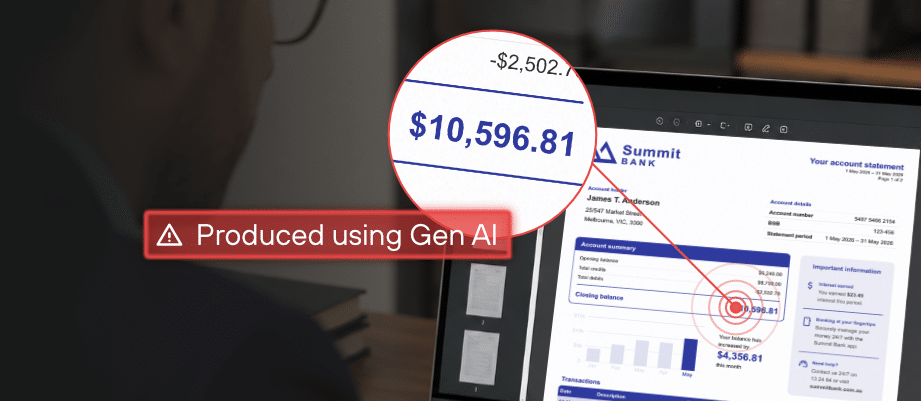
Its platform analyses documents and images for indicators of manipulation, fabrication and inconsistency, helping claims, fraud and risk teams identify suspicious material that may not be apparent through manual review or basic document checks.
For insurers, this allows documents and images to be assessed earlier in the claims process, when intervention can have the greatest impact. It also provides teams with more than a generic risk score. Fortiro helps identify the reasons evidence has been flagged, giving investigators and claims teams clearer information on which to base further review, escalation or challenge.
As fraudulent evidence becomes more convincing, the ability to determine whether a document or image can be trusted is becoming an increasingly important part of effective claims management. The next fraudulent claim may look entirely legitimate. The challenge is ensuring that insurers have the capability to determine when it is not.

Get a demo today
Get a demo of Fortiro’s income document verification platform to see how it can help you.