

Sep 16, 2026
Income Document Authentication: The Missing Layer in Identity Fraud Prevention

Data breaches, phishing and AI-driven scams have increased the availability of identity documents to be used for fraud. Once personal information is exposed, it can be reused in loan applications, account takeovers and other fraud attempts long after the original breach has left the headlines.
Australia is already seeing the scale of that risk. The Australian Government’s Credential Protection Register has now blocked more than 750,000 fraudulent identity verification requests since it was created in response to major data breaches. That is a clear sign that compromised identity details are not a theoretical risk. They are being actively tested and reused in real-world verification processes.
For banks, lenders, insurers, brokers and property managers, the practical lesson is clear. When a fraudster uses stolen but genuine identity data, traditional identity checks can still pass. The fraud often appears later in the workflow, in the documents used to prove income, affordability or financial position.
Why Identity Verification Alone Is No Longer Enough
Most organisations focus identity verification at the start of the application process. That remains essential, but it does not catch every high-risk case. This is especially true when a fraudster is using a real person’s information, a clean credit profile, or data that matches government, bureau or third-party sources.
That is why good identity verification can still approve the wrong person.
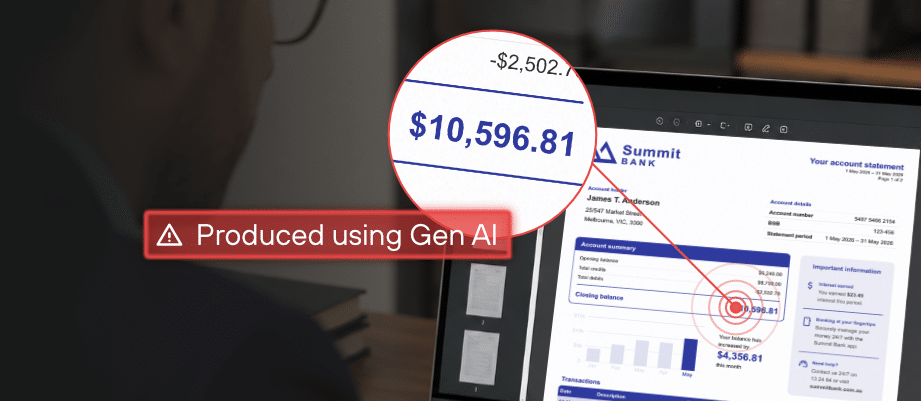
Once the identity layer looks credible, the next hurdle is proving income and affordability. This is where manipulated documents often enter the process, including altered payslips, edited bank statements, fabricated tax records and AI-generated supporting evidence.
Why Income Documents Are the Best Place to Catch Identity and Income Fraud
Income documents sit at a critical point in the application flow. They help determine whether an application moves from interest or conditional approval to a final decision.
The pattern is consistent across markets. Income evidence is where the application story either holds up or falls apart.
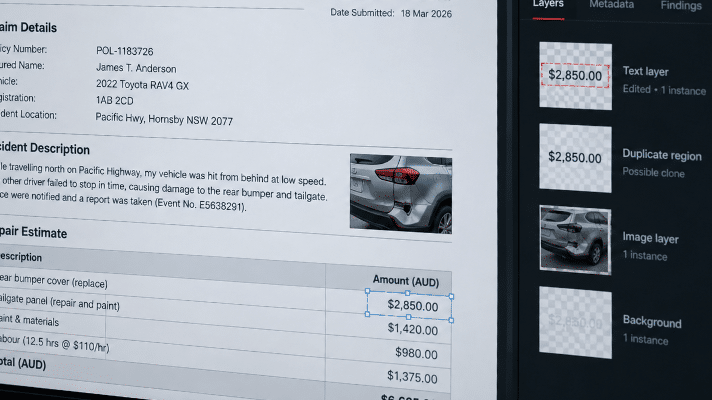
When a fraudster uses stolen or falsified identity data, they usually still need to create supporting documents that match the story. That creates detectable risk signals, including changed amounts, personal information, inconsistent dates, mismatched employer details, reused templates and other signs of manipulation.
This makes income document authentication a powerful second line of defence. It helps stop bad applications, but it also reduces victim harm by preventing someone’s identity from being used to secure credit, housing, insurance or services.
How AI Has Changed Document Fraud Detection
Modern document fraud is no longer limited to Photoshop edits. Shallowfakes, which are fast and simple manipulations, are now common and easy to do with readily available software. AI-generated deepfakes and synthetic documents are also improving quickly and very scalable, making visual review less reliable.
Fortiro’s approach is to assess documents beyond what a person can see on the surface. Instead of asking only whether a document “looks right”, Fortiro examines how the document has been constructed and where hidden anomalies suggest tampering or AI generation.
That matters in high-volume environments, where risk teams need fast decisions, consistent controls and clear evidence when a document is flagged.
A Stronger Application Flow
The application process does not need to become slower. It needs stronger controls at the right point.
A better flow looks like this: onboard the customer and complete IDV and KYC checks. Make a conditional decision based on available data. Authenticate income documents and compare them against the application. Then issue the final decision based on what the documents prove, not just what they claim.
If the strongest fraud control is still “a human will spot it”, the organisation is relying on the least scalable part of the process at the exact moment fraud is becoming more sophisticated.
The Outcome: Better Decisions, Fewer False Approvals and Less Victim Harm
Automated income document authentication gives lenders, insurers, brokers and property managers a practical way to strengthen identity fraud prevention without adding unnecessary friction.
It creates a second line of defence that is harder for fraudsters to bypass, even when they are using real identity data. It also gives risk, compliance and operations teams a clearer evidence trail: what was detected, why it mattered and what decision followed.
In today’s fraud environment, identity verification remains essential. But it is no longer enough on its own. The missing layer is income document authentication, because when the documents are wrong, the decision built on top of them is too.
Get a demo today
Get a demo of Fortiro’s income document verification platform to see how it can help you.