

Apr 2, 2026
Is CDR the Silver Bullet for Document Fraud in Lending?

By Sean Quagliani, Fortiro CEO and Co-founder
The 2026 Equifax (Australia) Fraud Index Report highlighted a 14.3 percent surge in false document credit listings, which, combined with recent press around AI-document fraud, is now seeing this industry challenge regain focus.
Lenders are under pressure to move faster, protect profitability/NIM and manage risk – including fraud controls. As AI continues to evolve, making fabricated or tampered financial documents harder to manually detect, CDR has been presented as the answer to this challenge.
It is easy to see why. CDR promises to reduce reliance on uploaded documents alone, by drawing information directly from borrower bank accounts.
But does that make it a complete answer to document fraud? Let’s explore.
Fortiro sees the Consumer Data Right (CDR) as a major step forward from screen scraping and an important part of modern lending workflows. The issue is not whether CDR has value. It clearly does.
The issue is whether it can, on its own, solve for income verification and reduce the prevalence of document fraud in lending (as opposed to just less documents).
My opinion is that it can reduce the volume of documents, but it comes with severe limitations which impact speed, competitiveness and risk management.
CDR Is Better Than Screen Scraping, But That Is Not the Whole Story
CDR is a regulated, consent-based mechanism for sharing financial data. That matters because it provides a more structured and secure approach than screen scraping, which relies on credential sharing and has long raised legitimate security concerns.
In that sense, CDR seems the better direction of travel.
However, better access to financial data should not be confused with fraud protection.
A more secure way of receiving account information does not remove the need to assess what that information means. Nor does it remove the need to test whether it aligns with the rest of the application. Lenders still need to interpret data, understand context and determine whether the overall picture can be trusted. That is where the conversation needs to become more precise.
Why CDR Alone Does Not Give Lenders the Full Picture
A transaction feed can show money entering an account. What it cannot always show clearly is the true nature of that payment.
A credit may appear to be salary but still be something else. It could be a transfer from another account. It could be staged funds. It could reflect irregular income or a one-off payment that should not be relied upon for serviceability.
This is one of the central limitations.
Income is not always straightforward, and variable income is especially difficult to assess from a single transaction line. Casual earnings, overtime, commissions, bonuses and contract income can all appear in ways that make accurate classification difficult. A lender may be able to see that funds were received without being able to determine with confidence whether that income is recurring, consistent and suitable to include in an assessment.
That creates risk.
Without supporting context, lenders can still miss important indicators that matter for both serviceability and fraud detection. The presence of incoming funds does not always tell the full story about their origin, reliability or legitimacy.
This means that lenders naturally take a conservative income verification outcome when relying purely on transactional data. They make credit policy rules such as “using the last 12 months of income”, which means that recent pay rises or bonuses can have a reduced impact on access to credit.
In a recent real-world customer deployment, Fortiro had feedback that where applications were using transactional data alone, or Superannuation data, that the loan had lower approval limits than those using payslips. This is because the payslip contains the most recent up-to-date income figure as opposed to historical data.
What this also means, is that competitors who support documents will be able to offer a larger limit whilst meeting all regulatory expectations.
Why Documents Still Matter in Lending
Documents remain important because they often provide detail that bank-feed data alone may not fully explain. In Fortiro’s experience, whenever questions are raised over income regularity or composition, lenders and insurers will ask for a document to perform additional verification. Close to half of all payslips in Australia have a deduction or allowance in them, which sets the scene for large numbers of these variable income figures – impossible to explain with just transaction data.
Payslips, business activity statements and other proof-of-income documents can help lenders understand employer identity, pay period, gross versus net income, year-to-date patterns, allowances and deductions. They provide important, up-to-date context around how income is structured, not simply confirmation that money has landed in an account.
That context is often critical.
When a lender is assessing the quality and consistency of income, documents can provide more detailed evidence that can complement transaction data, rather than compete with it, leading to a richer lending decision.
Convenience, Comfort and Reliability of Documents
Documents also continue to matter because customer preferences vary. Many consumers are comfortable sharing targeted documents that are directly relevant to the lending decision, while being less comfortable sharing a broader view of their accounts.
Unlike bank feeds, documents do not depend on any other party. When the borrower or broker decides to submit a document, they simply provide a PDF or image of the relevant document. And they can easily provide that document to one or many lenders, quickly, easily and securely.
With CDR, there are scenarios where providers are not supported, data quality issues exist and some providers suffer availability issues. All of these things disrupt a borrower or a broker from getting access to finance.
Lenders Fortiro work with are focussed on providing borrowers and brokers with convenient, secure and fast approval pathways which suit them – if a borrower or broker chooses to use CDR, then the Lender should have a pathway for that.
If the borrower or the broker chooses documents, then the Lender should have a fast, secure and fraud-protected pathway to provide a fast decision.
The Smart Approach Is Not CDR vs. Documents
This should not be framed as a choice between CDR and documents.
The stronger approach is layered verification.
CDR can provide fast, consent-based access to transaction data. Documents can provide context, explanation and evidentiary value. When the two are used together, lenders are in a stronger position to identify inconsistencies, test assumptions and detect fraud signals that may not be visible from a single source alone.
That is where better outcomes are achieved.
Where Fortiro Fits in the Lending Workflow
Fortiro helps lenders verify the documents that CDR does not replace, including payslips, tax documents and other financial records, making those documents a fast and automated pathway. It supports a wide range of financial document types and analyses fraud indicators across PDFs, scans, images and screenshots.
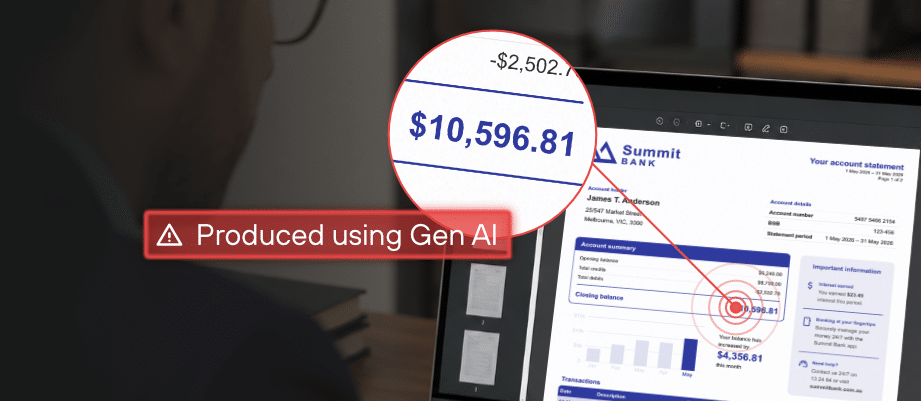
That capability matters because even in a more digital, CDR-enabled environment, documents still enter the loan file. They still influence lending decisions. And they can still be altered, fabricated or generated using increasingly sophisticated AI tools.
Fortiro is designed to help lenders identify those risks.
From PDF forgery to manipulated images and AI-generated financial documents, Fortiro helps organisations assess whether a document can be trusted. It also enables teams to compare what a document presents against what other data sources suggest, helping to surface discrepancies that may warrant closer review. In practical terms, Fortiro helps close the gap between data access and document truth.
The Hybrid World
At Fortiro, we believe we are entering into and will stay in a hybrid world for the foreseeable future. If we look to the UK as an earlier mover on Open Banking, this is where they are today.
CDR is a valuable development for lending. It is more secure and more modern than screen scraping, and it has an important role to play in the future of income verification.
But it is not a silver bullet for better credit outcomes, a better customer experience and certainly not going to eliminate income documents.
The strongest fraud controls do not depend on a single source of information. They combine digital data sharing, document verification and cross-source analysis to create a more complete and reliable picture of risk.
That is the key point for lenders. CDR helps lenders get data. Proof of income documents such as payslips provide the granular context. And Fortiro helps lenders trust what they are seeing.
Do you want a lending workflow that uses CDR without leaving document fraud unchecked? Fortiro helps lenders verify the documents and financial evidence that still sit at the heart of credit risk decisions.


Get a demo today
Get a demo of Fortiro’s income document verification platform to see how it can help you.