

Jun 16, 2026
AI-Generated Document Fraud in 2026: Why Lenders and Insurers Need Stronger Detection
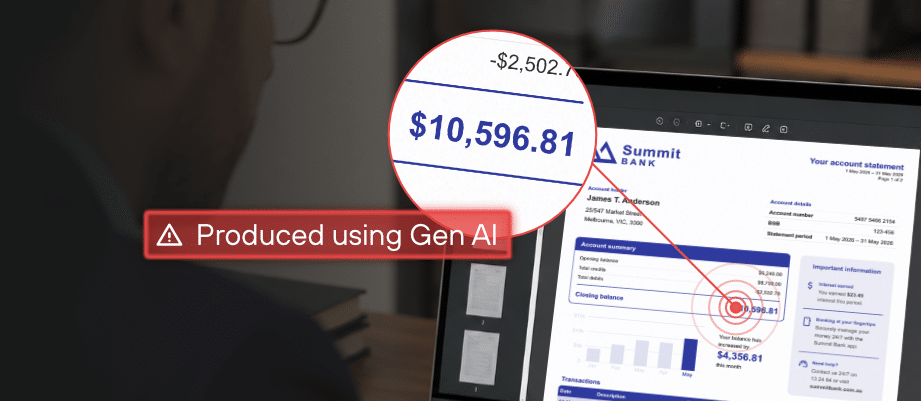
The rise of Generative AI has dramatically changed how fraudulent financial and identity documents are created. In just a few short years, what once required specialist software, technical skill or organised fraud networks is now being done in minutes using widely accessible AI tools.
Fraudsters can generate realistic income documents, fabricate invoices, or create supporting claims evidence at a scale and quality that traditional document checks were never designed to handle.
The speed of this evolution is one of the biggest challenges financial services institutions are facing today.
AI-generated documents are no longer poor-quality with obvious mistakes. They are increasingly polished, convincing, and difficult to detect through manual review alone. In many cases, a fully AI-generated document can appear to be a genuine file, complete with realistic layouts, formatting and visual consistency. As a result, these documents will bypass visual inspection and basic document verification measures.
The question for risk and fraud teams is no longer whether the document looks legitimate, It is whether the document can be trusted.
Fortiro Protect detects AI-generated documents and images, in real-time
Fortiro Protect enables lenders and insurers to detect AI-generated and manipulated documents and images using layered forensic analysis, metadata inspection, image analysis, file composition checks, and GenAI detection techniques.
Rather than relying on visual inspection alone, Fortiro Protect analyses forensic characteristics of a file to identify signs of fabrication, manipulation, or synthetic generation.
This is critical because many of the strongest indicators of AI-generated fraud are now invisible to the human eye. Fraud indicators can exist within image layers, pixels, metadata, font inconsistencies, layouts, or PDF composition.
Economic pressure and digital-first application processes are creating more opportunities for fraud. Loan applications, insurance claims, and onboarding workflows increasingly happen online, where documents play a critical role in decision-making. For fraudsters, that creates a high-value target.
The impact is already being seen across the market. Fortiro has observed a 110% increase in deepfake fraud documents in the last six months alone. Industry data reinforces the same trend, with organisations globally reporting rising levels of AI-enabled fraud attacks. KPMG Canada’s 2026 Business Fraud Survey found that 81% of businesses that experienced fraud said the attack was AI-enabled, while 94% of leaders said they expect AI-powered attacks this year. Yet despite the risks, only 26% have a comprehensive and tested response plan to defend against AI‑enabled attacks such as deepfakes and voice clones.
Manual review still has an important role to play, particularly when judgment and context are required. However, human review alone cannot scale to meet the speed, sophistication and volume of modern document fraud. The answer is not to slow processes down further. It is to apply smarter technology earlier in the workflow.
Fraud and compliance teams need more than a simple pass or fail outcome, and this is why Fortiro focuses on layered detection and explainable results. Fortiro provides visibility into why a document has been flagged as well as the evidence that supports escalation, investigation, and decision-making.
Fortiro helps detect fraudulent documents earlier, reduce risk, accelerate reviews, and make faster, more confident decisions in an era where document fraud has become more scalable, sophisticated and increasingly AI-driven.


Get a demo today
Get a demo of Fortiro’s income document verification platform to see how it can help you.